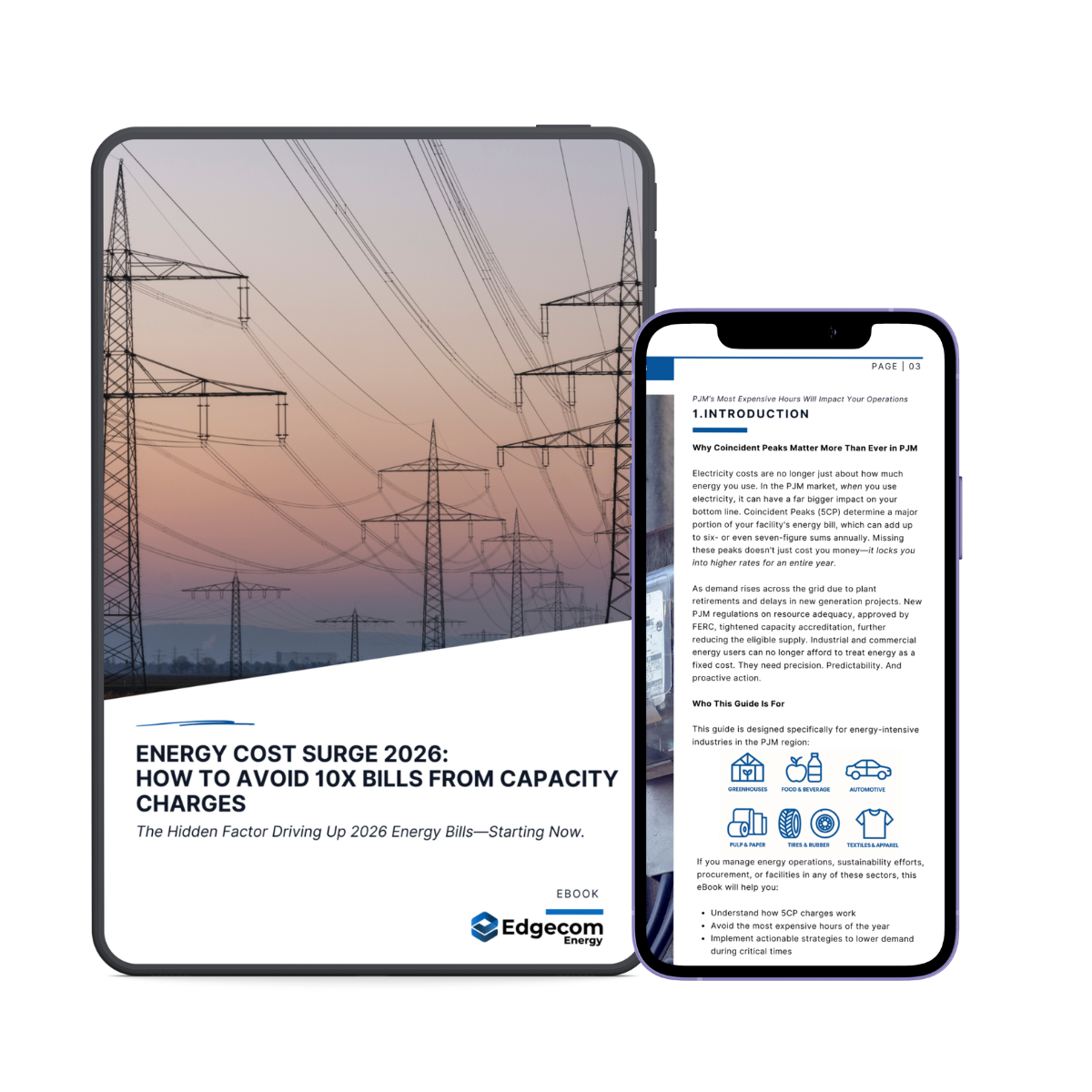
In the industrial and commercial sectors, your electricity bill is often misunderstood. Most operators focus on total consumption, but the real financial risk isn’t how much power you use over a month; it is how much you use during the grid’s five most stressful hours.
In regions like Ontario (Global Adjustment) and the PJM Interconnection, these five hours dictate a massive portion of your annual energy overhead. If your facility is running at full tilt during a grid peak, you aren’t just paying for power. You are setting a high PLC (Peak Load Contribution) factor that locks in expensive rates for the entire following year.
The $125K to $350K Multiplier
To put the scale of this risk into perspective, the financial impact of missing a peak is staggering. In the PJM market, Coincident Peak charges for Capacity and Network Transmission (NITS) have recently surged, with some zones seeing costs as high as $125,000 per megawatt-year.
In Ontario, the stakes are even higher. Under the Industrial Conservation Initiative (ICI), successful PLC management can be worth nearly $350,000 per megawatt-year.
Using high-intensity machinery or running your HVAC at max capacity during these critical windows creates a cost that often dwarfs the actual value of whatever you produced in those few hours. For many, this is the difference between a healthy operating margin and a year of “playing catch-up” on utility costs.
The solution isn’t to shut down operations and lose productivity. It is about Strategic Curtailment. By using high-precision alerting systems like pTrack®, facilities can identify these windows before they happen and execute a surgical PLC management plan.
Precision over Interruption: How to Curtail Smartly
Industrial curtailment is often misunderstood as “turning the lights off.” In reality, it is an exercise in intelligent load shifting. Successful PLC management involves identifying non-critical loads that can be throttled for two to four hours with zero impact on primary throughput.
| Asset Class | Curtailment Strategy | ROI Impact |
| HVAC & Chillers | Pre-cool the facility early; cycle fans during peak hours. | High (Invisible to production) |
| Battery/EV Charging | Pause charging cycles during the alert window. | High (Zero operational cost) |
| Pumps & Motors | Stage non-essential fluid movement or grinding tasks. | Moderate (Process-dependent) |
| Ancillary Systems | Compressors, lighting, and non-essential heating. | Consistent (Low effort) |
The ROI: Protecting Your EBITA through PLC Management
Every kilowatt you shed during a peak event is a direct injection into your bottom line. Reducing your Peak Load Contribution lowers your “cost to manufacture” or “cost to occupy.”
For Industrial Facilities, Proactive PLC management creates a significant competitive edge. It enables more aggressive pricing and higher margins than unoptimized competitors. These are non-dilutive savings that go straight to your EBITA.
The advantages are transferred to your tenants in commercial buildings. Reducing peak fees increases the predictability of common-area maintenance costs, improving the appeal of your buildings and freeing up funds for modernizing common areas or HVAC improvements.
Risk mitigation and operational excellence
Curtailment creates a more resilient facility that extends beyond the balance sheet. By reducing demand during grid stress, your building acts as a “Virtual Power Plant.” This lowers the possibility of brownouts that result in unscheduled equipment shutdowns or data loss and helps stabilize the local grid.
How the pTrack® Protocol Works
- Advance Warning: You receive an alert between 4 and 24 hours in advance via your dashboard, text message, phone, and email. Additionally, you will receive a weekly forecast email.
- Surgical Action: Your team executes a pre-planned Curtailment Action Plan to shed non-essential load without stopping production.
- Real-Time Tracking: You monitor your performance in real time to ensure you are hitting your reduction targets.
- Annual Results: You watch your Peak Load Contribution (PLC) drop, locking in lower rates for the next twelve months.
Managing energy peaks is no longer just a “green” initiative. It is a fundamental strategy for financial health and site reliability.
Stop Overpaying for Your Peak Demand
Don’t let five hours of grid stress dictate your entire year’s energy budget. Whether you are navigating Ontario’s $350K/MW Global Adjustment or PJM’s $125K/MW capacity charges, PLC management is your best defense.
Contact Edgecom Energy today to see how pTrack® can transform your energy data into a competitive advantage. Our team will help you identify your curtailment potential and start protecting your operating margins immediately.