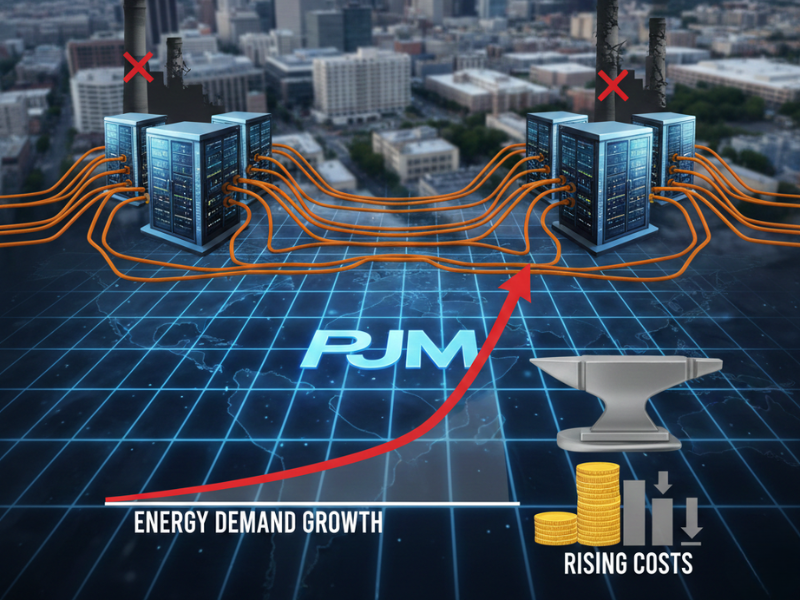
The PJM energy market, the largest in North America, is currently facing a challenge that has never occurred before. It is hitting the bottom line of business and industrial leaders. The grid is now experiencing high growth after 10 years of flat demand. This is due to the rapid growth of data centers and the closure of many power plants.
The Main Problem: A “Perfect Storm” for Prices
There is a massive imbalance between supply and demand in the PJM market. Some of the main reasons for this spike are:
- Quick retirements of older power plants: More than 6,600 MW of old power plants have shut down recently, reducing the total power available.
- Explosive Load Growth: The AI boom and data centers have increased projected peak demand from 150,640 MW to 153,883 MW for the next cycle.
- Changes in the rules: New reforms approved by the FERC have altered how reliability is valued, leading to higher clearing prices in annual capacity auctions.
What happened? In some places, capacity prices have gone up by almost 10 times. For example, they went from about $10,560/MW-year in 2024 to a predicted $120,147/MW-year by 2026.
Areas Most Affected
The entire PJM area is feeling the heat, but some utility zones and states are seeing the largest increases in capacity and transmission (NITS) fees.
| Utility Zone | State | Capacity Charge (Approx.) | Affected Threshold |
|---|---|---|---|
| PSEG | New Jersey | $271k/MW-Year | Customers > 500kW |
| JCPL | New Jersey | $225k/MW-Year | Customers > 500kW |
| ACE | New Jersey | $144k/MW-Year | Customers > 500kW |
| PPL / PECO / DLC | Pennsylvania | $100k/MW-Year | Customers > 100kW |
| ComED | Illinois | $100k/MW-Year | Customers > 400kW |
The answer is strategic demand management.
To stop these increases, business leaders need to switch from passive consumption to active load management.
1. AI-Based Peak Prediction
Edgecom Energy’s pTrack® is a modern solution that uses machine learning to make accurate predictions. These models are 99.1% accurate at predicting PJM demand and prices, which helps facilities stay ahead of real-time grid stress without stopping production.
2. Useful ways to cut back
Facilities can lower their PLC in a big way by taking a few important steps:
Alignment of Maintenance: Plan shutdowns to happen on days when you expect the most work.
Consumption Shifting: Move heavy production processes or extra loads (like HVAC and pumps) to times when demand is low.
Distributed Energy Resources: Send backup generators or Battery Energy Storage Systems (BESS) to the grid during peak hours to lower demand.
3. Possible savings in the real world
Strategic cuts can bring in a lot of money. For instance, a facility that uses 1,000 kW and cuts its load to 500 kW during the five CP peaks could save more than $60,000 a year. In the next cycle, which will take place in 2026 and 2027, the possible savings could be as high as $120,147 per MW of curtailed load.
Next Steps
You don’t have to let rising energy costs get out of hand. Industrial leaders can turn bill increases into big savings by using real-time analytics and predictive technology to outsmart the grid. Have one of our energy experts review your bills for an honest assessment of curtailing during the 5CP.
Download our latest brochure, explaining PJM’s 5CP Mechanism.