There’s a moment most energy managers know well. The monthly utility bill arrives, the numbers are worse than expected, and the next hour is spent trying to reverse-engineer what happened three weeks ago. Which shift ran hot? Was it that stretch of humid days in July? Did someone forget to cycle down the compressors over the long weekend?
It’s not a great way to run an energy program. And yet, for the majority of commercial and industrial facilities, this is still the default: manage energy by looking backward.
The facilities that are pulling ahead — the ones consistently trimming six and seven figures off their annual energy spend while also earning revenue from the grid — have made a different choice. They’ve stopped treating energy as an accounting line item and started treating it the way a trading desk treats a position: with live data, defined rules, and the discipline to act in real time. The foundation that makes this possible is real-time energy monitoring — and once it’s in place, almost everything else about how you manage energy gets easier.
The shift isn’t as complicated as it sounds. But it does require a fundamentally different relationship with your facility’s data.
The Problem with Reactive Energy Management
Reactive energy management isn’t just slow — it’s structurally incapable of capturing the most valuable opportunities in today’s energy markets.
Grid programs like Demand Response, coincident peak avoidance (think Global Adjustment in the IESO market, or the 5CP mechanism in PJM), and time-of-use rate optimization all have one thing in common: the window to act is measured in minutes, not days. When a grid operator signals a curtailment event, or when a peak-risk period begins to develop on a hot August afternoon, your facility either has the situational awareness to respond — or it doesn’t.
If your team is working off yesterday’s reports or last month’s bills, you’re already out of the game before it starts.
There’s also a compounding problem: reactive management tends to create a culture of guessing. Without reliable, real-time data, operators default to conservative rules of thumb — curtailing when they probably don’t need to, or missing events entirely because they weren’t sure the signal was real. Both outcomes cost money. Unnecessary curtailments disrupt operations. Missed events mean missed revenue and, in some programs, penalty exposure.
What Proactive Energy Management Actually Looks Like
Think about how a trading desk operates. Traders don’t wait for the end-of-month P&L to understand their exposure. They’re watching live positions, monitoring market signals, working within a set of pre-defined rules, and making calculated adjustments in real time. When conditions change, they act — not because someone filed a report, but because the information was right in front of them.
High-performing energy teams are starting to operate the same way.
Here’s what that looks like in practice across a few scenarios:
Scenario 1: Demand Response in Ontario
A manufacturing facility enrolled in an IESO Demand Response program used to get an event notification and then scramble — calling the floor supervisor, debating whether to curtail one line or two, and often making the call too late. After building out a real-time energy monitoring layer, the same team can see live load by asset, compare it against the curtailment target, and know within seconds exactly which equipment to shut down and in what sequence to hit their obligation cleanly. No scramble. No guesswork. And because they’re hitting their targets consistently, their DR revenue has become a reliable line on the CFO’s quarterly forecast.
Scenario 2: Coincident Peak Management in PJM
In the PJM footprint, a facility’s capacity charges for the entire following year are determined by its load during just five specific hours — hours that aren’t announced in advance. Facilities that operate reactively often curtail dozens of times per summer trying to catch those five peaks, disrupting production repeatedly and still sometimes missing one. Facilities with live grid data and predictive analytics can narrow the field dramatically — reducing curtailments to the handful of days that genuinely matter, protecting uptime, and hitting the peaks that move the needle on next year’s bill.
Scenario 3: Time-of-Use and Demand Charge Optimization
For facilities in markets with complex tariff structures — tiered demand charges, time-of-use pricing, or transmission surcharges — the value of real-time visibility compounds daily. An operations team that can see their demand trajectory building toward a new monthly peak can make a ten-minute operational decision that saves thousands of dollars. Teams that find out about the new peak when the bill arrives can only calculate what they lost.
The Data Foundation That Makes It Possible: Real-Time Energy Monitoring
None of this works without the right data layer underneath it. And this is where many organizations get stuck — not because they lack ambition, but because their current setup creates too many blind spots.
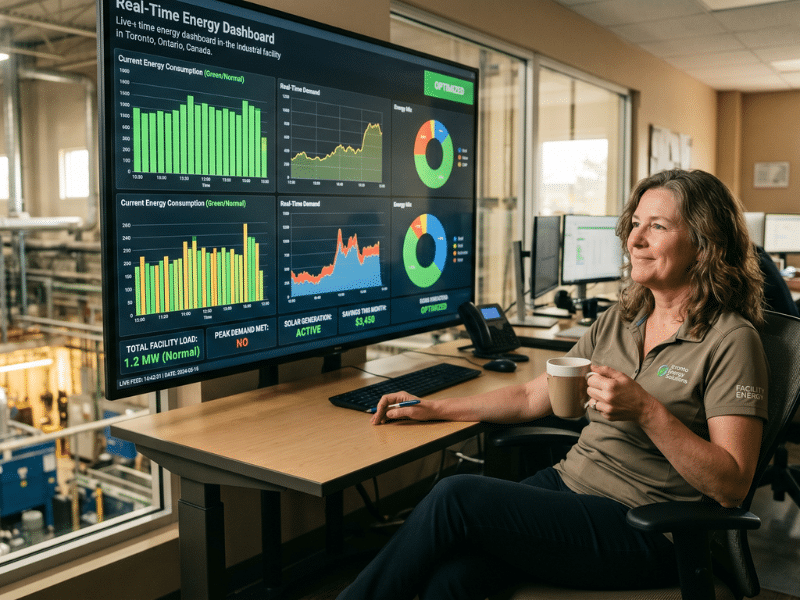
Real-time energy monitoring means knowing what every significant load in your facility is consuming right now — not as of last night’s report, not from this morning’s manual meter read, but at this moment. Without that, every decision about curtailment, load shifting, or demand charge avoidance is a guess dressed up as a strategy.
Common gaps that undermine proactive energy management include:
- Utility-meter-only visibility. The utility meter tells you what the whole building used. It doesn’t tell you which production line, HVAC unit, or process drove the spike. Without sub-metering or asset-level monitoring, you can’t act with precision — you can only blunt-force curtail everything and hope for the best.
- 15-minute interval data reviewed weekly. Interval data has tremendous value, but only if it’s being read in something close to real time. Teams that pull interval reports at the end of the week are getting a history lesson, not operational intelligence.
- Disconnected systems. When grid data, facility load data, production schedules, and billing data all live in different places — or require manual aggregation — the synthesis that enables smart decisions never happens. By the time someone has assembled the picture, the moment has passed.
The facilities managing energy like a trading desk have solved this problem by building a real-time energy monitoring layer that centralizes their data into a single operational view — one that brings together live consumption readings at the asset level, grid pricing and event signals, and cost forecasting, all in one place. When that picture exists and is always current, the right call becomes obvious.
The Revenue Side of the Equation
It’s worth dwelling on the revenue piece, because it tends to get underweighted in energy conversations that are framed primarily around cost reduction.
Grid programs are paying facilities real money to be flexible. Demand Response programs administered through ISOs like the IESO in Ontario offer capacity payments just for being enrolled and available, with additional performance payments when events are called. Coincident peak programs reward facilities that reduce their load during the highest-stress hours of the year with dramatically lower transmission and capacity charges in the year ahead. In some markets, facilities with behind-the-meter storage assets can participate in ancillary services markets — getting paid to provide grid stability on an ongoing basis.
The facilities capturing this revenue aren’t doing anything exotic. They’re simply operating with enough visibility to respond when the grid asks them to. The data infrastructure they’ve built to reduce costs turns out to be the same infrastructure that unlocks a new revenue stream. That’s a rare case of two business outcomes sharing the same foundation.
For CFOs, the framing is straightforward: energy management is no longer just a cost center. The combination of cost optimization and grid program revenue means that the right energy strategy can have a measurable, positive impact on EBITDA — not just on the utility expense line.
Where to Start: Building Your Real-Time Energy Monitoring Foundation
The gap between reactive and proactive energy management can feel wide, but the path across it is more incremental than it appears.
The foundational question is simple: do you have real-time energy monitoring in place at a level of granularity that lets you act?
If the answer is no — if your team is working off monthly bills, end-of-day reports, or utility interval data reviewed after the fact — the first move is building that visibility. That means metering at the asset or circuit level, and aggregating that data into a platform that surfaces it in real time with context (costs, trends, benchmarks, grid conditions).
Once that foundation exists, the next layer is connecting it to grid intelligence — understanding what programs your facility is eligible for, what signals to watch, and how your operational decisions in any given hour map to program performance and cost outcomes.
That’s when the shift happens. Energy stops being something you reconcile after the fact and becomes something you actively manage — the same way the best-run teams manage any other strategic asset.
The Bottom Line
The energy grid is more complex and more dynamic than it was a decade ago, and that trend is accelerating. The cost of electricity is increasingly driven by when and how you use it — not just how much. And the programs that reward flexible, responsive facilities are growing in value and number.
Facilities that wait for the bill to find out how they performed will keep leaving money on the table. The ones that invest in real-time energy monitoring — and build it into how their operations teams make decisions — will find that the grid’s complexity, rather than being a burden, becomes a competitive advantage.
The trading desk mindset isn’t a metaphor. It’s a management posture — and the facilities adopting it are separating themselves from the pack.
Edgecom Energy helps commercial and industrial facilities, MUSH-sector organizations, and energy developers build the real-time energy monitoring foundation for proactive energy management. Our platform combines live facility data, grid analytics, and AI-powered insights to help your team reduce costs, earn grid program revenue, and make faster, smarter energy decisions.
Curious what real-time energy monitoring could look like for your facility? Get in touch.