If you are managing energy for a large operation in Ontario, you know that the “status quo” for your power bill is officially a thing of the past. Our grid is undergoing a massive structural shift, and if you are a Class A customer, your ability to plan for the next decade depends on one specific variable: a reliable IESO Global Adjustment Forecast.
As we move toward 2040, the Global Adjustment (GA) isn’t just a line item anymore; it is a moving target shaped by multi-billion-dollar nuclear projects and a rapidly changing supply mix.
Why the Old Rules No Longer Apply
For years, many businesses relied on historical trends to predict their costs. However, Ontario’s move toward electrification and the refurbishment of the nuclear fleet are changing the math. Between the Darlington project and the potential $26.8 billion Pickering refurbishment, the “cost stack” that must be recovered through the GA is growing significantly.
At the same time, we are seeing a shift in how the province handles peak demand. We are moving toward a dual-peaking system in which winter heating and EV charging create additional stresses on the grid. This means the windows for peak shaving are shifting, making a long-term IESO Global Adjustment Forecast essential for anyone looking to invest in onsite storage or demand response.
The Risk of Tightening Margins
One of the most eye-opening trends in our latest research is the volatility in the Capacity Auction. We have seen clearing prices jump by as much as 5x in a single cycle when system margins get tight. These price surges are a signal that the cost of reliability is going up, and those costs eventually flow through to your bottom line via the GA-OPA component.
Data-Driven Strategy for Class A Users
Our team has modeled three distinct paths for the Ontario grid through 2040: Business-as-Usual, Base Case, and Net Zero. Each of these scenarios creates a different reality for your GA rate. For instance, our data identifies specific years where rates may hit a local low, such as a projected $282,000/MW under certain conditions, before climbing toward highs of over $630,000/MW as long-term drivers take over.
Having this level of foresight allows you to time your capital projects for maximum impact. Whether you are evaluating a battery storage system or adjusting your production schedules, you need to know where the market is heading, not just where it has been.
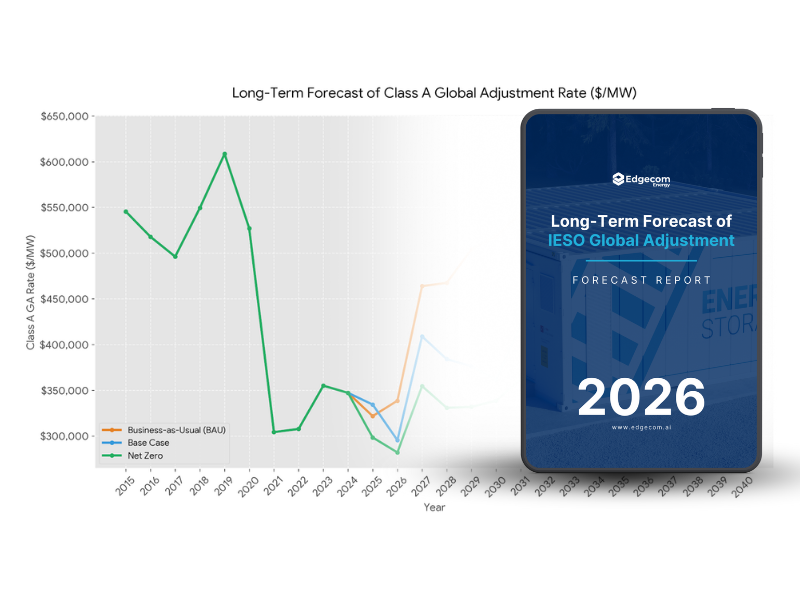
Get the Full 2040 Outlook. We provide the deep-dive data that CFOs and Energy Managers need to protect their margins. Our 26-page report breaks down every GA determinant to give you a clear 15-year roadmap.