
Why U.S. Mid-Atlantic Capacity Prices Are Rising — and What to Do About It
If your facility operates in the U.S. Mid-Atlantic region, you’ve probably noticed capacity charges, also called coincident peak (CP) charges, climbing higher each year. These costs are tied to how much electricity your site uses during the U.S. Mid-Atlantic’s highest-demand hours in the summer. With demand in the region growing faster than ever, capacity prices are becoming a much bigger piece of commercial and industrial energy bills.
By knowing the right strategies, businesses can manage these costs, predict peaks more effectively, and even turn demand reductions into revenue opportunities.
What’s Happening in the U.S. Mid-Atlantic Market?
The U.S. Mid-Atlantic grid is the largest electricity market in North America, covering 13 states plus Washington, D.C., and serving over 65 million people. For more than a decade after 2008, electricity demand in the U.S. Mid-Atlantic was mostly flat because of energy efficiency improvements. But today, that’s changed.
- In 2024, the U.S. Mid-Atlantic hit a summer peak of 152,666 MW, which was 6,600 MW higher than the year before.
- By 2025, demand reached 160,157 MW at peak—a dramatic jump that shows how fast consumption is rising.
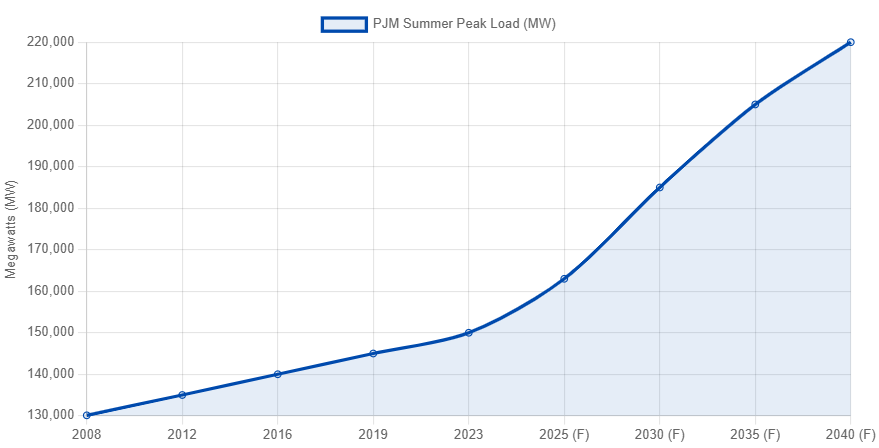
This surge in demand is happening at the same time that many power plants are retiring, leaving less supply available to meet growing needs. To make matters more complex, regulatory changes are reshaping how reliability is valued, often increasing costs for end users.
Why Are Capacity Prices Increasing?
Several key factors are behind the sharp rise in U.S. Mid-Atlantic capacity costs:
- Power Plant Retirements: More than 6,600 MW of generation was retired compared to the last auction, shrinking available supply.
- Higher Peak Demand: The U.S. Mid-Atlantic grid operator raised its demand forecast from 150,640 MW to 153,883 MW, which increases strain on the grid.
- Climate and Extreme Weather: Extreme weather events are pushing peaks higher and making them harder to predict.
- Electrification: The growth in electricity use in EVs, heat pumps, and industrial electrification drives electricity use.
- Data Centers and Manufacturing: Onshoring of factories and a surge in data centers are fueling regional consumption.
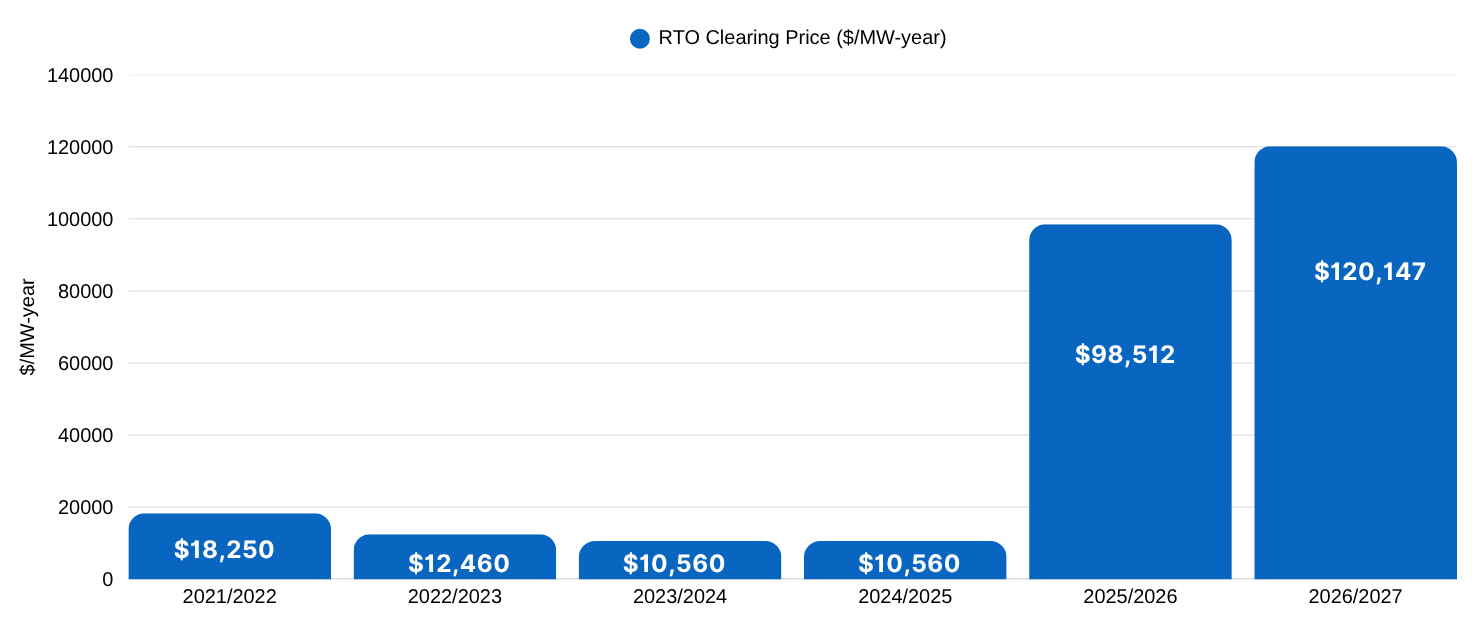
The combination of more demand, less supply, and stricter reliability requirements is causing capacity auction prices, which in turn cause customer CP charges, to rise sharply.
The Challenge of Predicting Coincident Peaks
Capacity charges in the U.S. Mid-Atlantic are based on the five highest one-hour demand periods across the summer (June–September). These are called 5CPs. The tricky part? No one knows which hours they’ll be until after the season ends.
That means businesses often end up curtailing load many times in the summer, hoping to catch the peaks. Using this approach is not recommended, as it will disrupt operations and could cost your facilities; on top of that, there’s potential to miss the mark from time to time. Forecasting CPs is becoming even more difficult; unpredictable weather and new demand drivers have made it hard to accurately predict these costs.
Solutions: How Businesses Can Reduce CP Costs
While capacity prices are rising, there are practical steps businesses can take to lower their exposure and even generate revenue.
1. Curtailment Action Plans (CAPA)
A Curtailment Action Plan and Analysis is an energy plan to help you plan for your curtailment. The plan includes analysis of load profile, calculation of potential curtailment and program revenue, breakdown of your facility’s consumption trends, risk/mitigation strategies, and recommendations for next steps.
2. Demand Response Programs
Programs like the U.S. Mid-Atlantic’s Emergency Load Response Program pay businesses for cutting load during grid emergencies. This provides a revenue stream on top of lowering your capacity charges.
3. Load Shifting and Flexibility
Facilities can move certain processes to off-peak hours, align peak curtailments with maintenance, or shift auxiliary loads. These strategies allow for cost savings without disrupting core production.
4. Advanced Forecasting & Analytics
AI-driven prediction tools and real-time monitoring can give a significant edge to businesses. By using machine learning, IoT sensors, and Energy Management Systems (EMS), facilities can anticipate peaks more accurately, reduce unnecessary curtailments, and capture savings.
5. Energy Storage & Distributed Energy Resources (DERs)
On-site generation and storage, like batteries, can be deployed during peaks. Instead of shutting down operations, you can discharge stored energy to reduce your CP contribution, keeping your business running smoothly while cutting costs.
Look No Further—Edgecom Does It All
If you’re wondering how to stay ahead of the U.S. Mid-Atlantic’s rising capacity costs, look no further. Everything we’ve covered, from curtailment planning and AI-driven peak prediction to real-time monitoring, demand response participation, and DER integration, is exactly what Edgecom Energy specializes in.
We don’t just give you the tools; we provide a complete, end-to-end strategy tailored to your facility. Our team works closely with you to analyze your energy profile, build actionable curtailment plans, and optimize participation in U.S. Mid-Atlantic programs so you reduce costs and earn new revenue without disrupting operations.
With Edgecom, you’re not left guessing which hours to curtail or how to manage complex program rules. We deliver predictive insights, automation, and hands-on support that take the uncertainty out of peak season.
At a time when capacity charges are only getting higher, partnering with Edgecom means turning a growing challenge into a clear opportunity for savings and stability.
Why This Matters
Capacity charges in the U.S. Mid-Atlantic are no longer a small line item on energy bills—they can amount to tens or even hundreds of thousands of dollars per year for large facilities. As demand continues to rise, these charges will only become more significant.
Organizations that adopt smarter demand management strategies today will not only protect their bottom line but also improve resilience against future price pressures. With the right tools and planning, what feels like a growing risk can become a manageable—and even profitable—opportunity.